

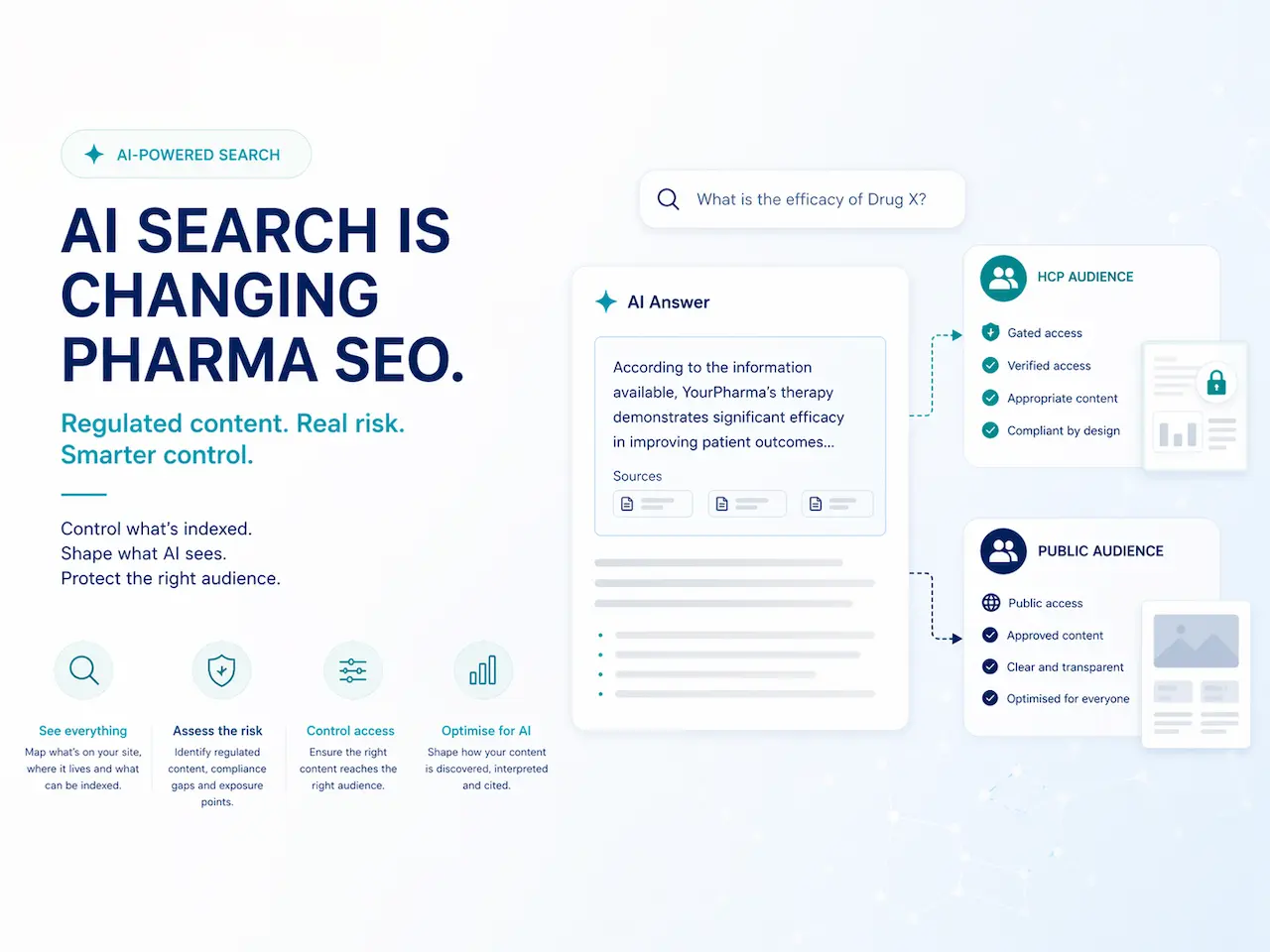
This article is a follow-on to our earlier piece on how AI search is changing pharma SEO. That article looked at how AI-mediated search is reshaping visibility and what that means for content structure, retrieval and discoverability. This follow-on looks at the next practical question: can AI tools actually find, interpret and surface your content in the right way?
For regulated healthcare teams, that is no longer a niche SEO question. It is now a discoverability, governance and audience-control question.
That changes the job of a regulated website. It is no longer enough for content to exist. It has to be findable, interpretable, current and structurally clear. It also has to avoid being surfaced in the wrong context.
Many teams still assume this is mainly a content or SEO issue. It is not. In regulated environments, the bigger question is whether your digital estate is exposing content in ways that are unclear, outdated, poorly governed or difficult to control.
Why this matters now
When an HCP asks ChatGPT, Claude or Perplexity a clinical or treatment-related question, the answer is assembled from sources the model judges to be relevant, trustworthy and easy to interpret. If your content is not part of that layer, you lose visibility. If the wrong content is surfaced to the wrong audience, you may create a different problem altogether.
That is the shift many pharma teams still have not fully absorbed. The risk is not only that your site is absent from AI-led search. It is that your content estate may already be exposing pages, PDFs or legacy materials in ways that are hard to govern, hard to interpret and harder still to control once third-party systems begin retrieving them.
Why some content appears and some does not
AI systems tend to favour content that is structurally clear, current, easy to parse and supported by visible trust signals. That usually means pages with direct answers, sensible heading structures, internal consistency, clear ownership signals, and content published as structured web pages rather than buried in documents.
Pharma companies should have an advantage here. They often sit on credible, specialist content. But many regulated sites make that content harder to retrieve than it needs to be. Important answers are buried. Audience intent is unclear. Valuable information sits inside PDFs, slide decks or legacy documents that were never designed to be interpreted in an AI-mediated search environment.
A 30-minute first-pass check
You do not need a large programme of work to spot the early warning signs.
- Start by listing five questions your website should answer for HCPs, medical stakeholders or relevant buyers.
- Then ask those questions in ChatGPT, Claude and Perplexity without mentioning your company name. Note whether your brand, domain or content is cited, summarised or linked.
- Next, repeat the exercise with your company name included. Check whether the answer is accurate, current and complete.
- Then test patient-phrased queries as well. That is often where audience leakage starts to become visible.
The point is not to produce a perfect scorecard. The point is to identify patterns.
- Where are you visible?
- Where are you absent
- Where is outdated or third-party material doing the explaining for you?
- And where might HCP-facing content be surfacing in ways that were never intended?
Where the compliance risk starts
This is the part many teams underestimate.
In a conventional website journey, audience separation can feel manageable. You create HCP areas, patient areas, gated sections and access rules. But AI search does not always respect the neatness of those original journeys. It can extract, summarise and re-present content outside the context in which it first appeared.
That does not mean every surfaced answer is automatically non-compliant. But it does mean regulated teams need to look more closely at what is publicly accessible, what is indexable, what can be crawled, and what signals are being sent about audience intent.
It also raises a broader operational question. If your content team, regulatory team and digital team do not have a shared view of what should be public, what should be gated, what should be indexed and what should be retired, then AI search will expose that ambiguity faster than traditional search ever did.
What to fix first
Start with the changes that improve both discoverability and control.
Rewrite key headings around real questions your intended audience is asking. If a page heading reflects an actual information need, it is easier for both search engines and AI systems to interpret it correctly.
Move high-value information out of PDFs where possible and into structured HTML pages. Documents still have a role, but if the information matters commercially or operationally, it should not live only in a format that is harder to parse and harder to govern.
Review older pages and downloadable files for accuracy, audience fit and continued necessity.
Finally, check whether your gating and indexation logic still reflects reality. A page that is technically public but assumed internally to be “effectively HCP-only” is exactly the sort of grey area that creates avoidable risk.
The more useful question
The question is not simply whether your pharma site is winning in AI search.
The more commercially useful question is whether your content is visible, interpretable and being surfaced in ways that support trust, clarity and audience control.
That is a better standard for regulated teams. It is also a more useful starting point for deciding what to fix first.
 Search Visibility & AI Governance Audit
If you are not sure what your site is exposing, what is being indexed, or how AI tools are interpreting your content, that is now a meaningful digital risk.
Our Search Visibility & AI Governance Audit is designed to help healthcare and pharma teams assess:
- what pages and documents are publicly available
- what should and should not be indexed
- what is currently being indexed
- where HCP gating exists and how robust it is
- where potentially regulated or audience-sensitive content may be exposed
- how well the site is structured for traditional search and AI discoverability
- what to prioritise first from a governance, visibility and content-risk perspective
The audit combines a content exposure, indexing and audience-risk review with a search visibility and AI discoverability review, followed by a working session to discuss findings, gaps and next actions. Learn more.
