

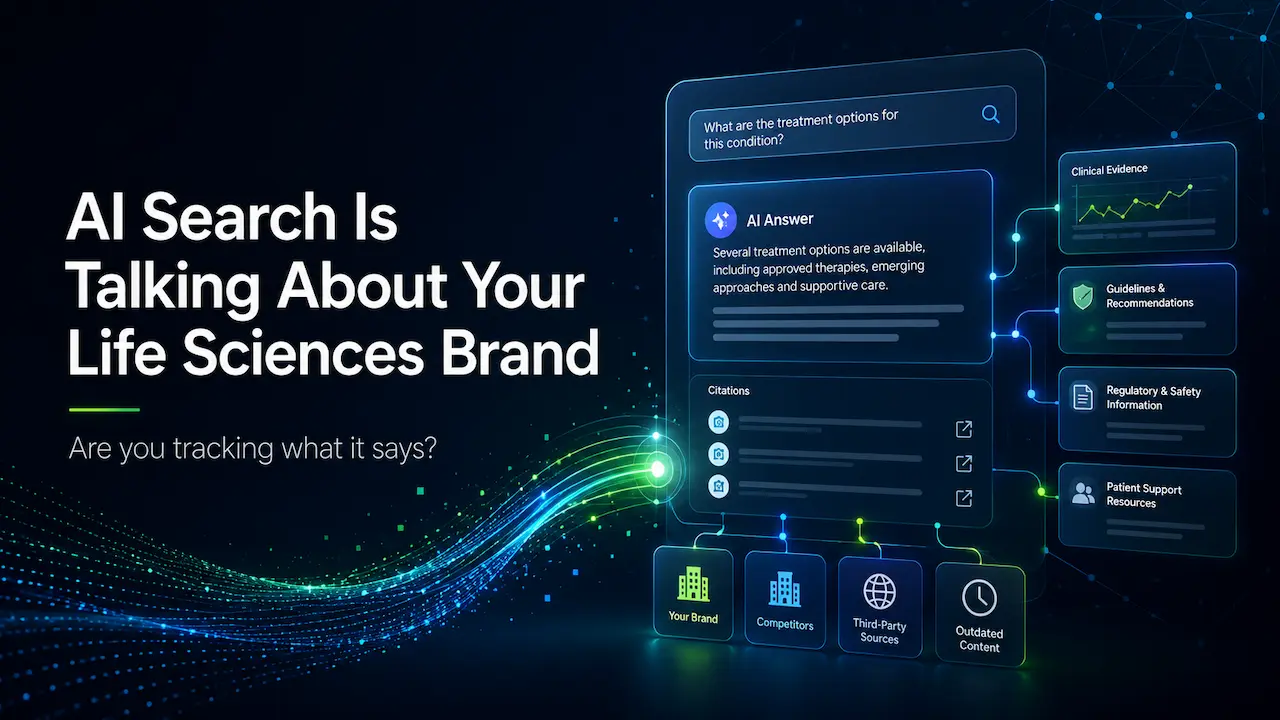
Pharma, biotech and medtech teams have spent years worrying about what appears on their own websites. The harder problem now sits somewhere else entirely. An AI system may be explaining your brand, your pipeline, your therapy area or your technology to someone right now, and you have no visibility of what it is saying.
This is the shift a lot of life sciences teams are still underestimating. Search has stopped being a tidy list of links. More and more often it arrives as an answer: a summary, a recommendation, a compressed version of the web, assembled before anyone reaches your site.
For regulated, medical and science-led organisations, that should give pause. When an AI tool summarises a therapy area, a treatment option, a device category, a diagnostic pathway or a patient support service, it rarely just repeats your approved content. It interprets it. It blends it with third-party material. It drops context, cites a source you would never have chosen, or names your brand without ever linking back to you. Your analytics, meanwhile, will most likely tell you none of this.
From SEO to AEO and GEO
Most marketers in life sciences are comfortable with SEO: making content visible and useful in traditional search engines. AEO, answer engine optimisation, asks whether that content is clear and structured enough to be picked up in answer-led environments. GEO, generative engine optimisation, goes further again, asking whether generative AI systems can understand, summarise and cite your content accurately when they build an answer.
None of this is a rebrand of SEO. It changes the central question from:
“Where do we rank?”
to:
“What does AI say when someone asks about us, our therapy area, our technology or the problem we help solve?”
That is a very different visibility problem.
Why this matters now
None of this is a distant trend. OpenAI says more than 230 million people worldwide ask health and wellness questions on ChatGPT every week, and Axios, citing an OpenAI report, puts the number turning to it for health information at more than 40 million a day. In the UK, clinical use is no longer marginal either. Research from the Nuffield Trust and the RCGP found that 28% of GP respondents were already using AI tools in practice. Google is shifting too: Conductor’s 2026 AEO/GEO benchmarks found AI Overviews on just over a quarter of searches overall, but on almost half of healthcare searches.
That does not mean SEO is dead. It means the surface area of search has grown. Your audiences may still go to Google, and still reach your website, but before they do they may meet an AI-generated answer that frames the topic for them. That framing carries weight.
In January 2026, The Guardian reported cases of Google AI Overviews producing misleading health information. The uncomfortable lesson was not that AI can be wrong, which everyone already knew. It was that health information can be summarised in ways that strip out nuance, context and safety-critical caveats.
For life sciences organisations, that is the crux. Your content can be accurate, your website compliant, your scientific story clear and your prescribing or intended-use information up to date, and an AI-generated answer can still flatten the line between HCP-facing and patient-facing material, blur promotional and non-promotional contexts, misread a scientific platform, over-simplify a device claim, or summarise a complex topic without the safeguards your review process exists to provide. That is not only a search problem. It is a governance one.
Different sectors, the same visibility problem
The specifics vary across life sciences, but the shape of the problem stays the same. In pharma, the exposure tends to cluster around compliance: promotional boundaries, prescribing information, therapy-area content, and the line between HCP and patient context. Biotechs face a different risk, that AI misreads the science, underplays the pipeline, misses what makes the platform distinctive, or leans on outdated third-party summaries. For medtech, an answer engine might describe a device or use case without the evidence, caveats or intended-use framing that regulation depends on. In diagnostics, a test or pathway can be summarised without properly reflecting its accuracy, limitations, availability or clinical interpretation. Digital health companies may find their app or data proposition discussed with no mention of clinical safety, evidence, interoperability or privacy. And for CROs, CDMOs and specialist service providers, the issue is often more commercial than clinical: whether AI grasps what you do, where you fit and why you are credible, and whether you surface at all when buyers are researching partners.
Different sectors, then, but one underlying problem. AI is becoming an interpretive layer between your organisation and the people you need to reach.
Specialist health AI will raise the stakes
The next wave will make all of this harder to ignore. ChatGPT Health, Claude for Healthcare and Life Sciences, and Microsoft’s healthcare work around Copilot all point the same way. AI is moving closer to clinical conversations, personal health records, research tasks and the day-to-day administration of healthcare.
In the UK, adoption will not be a straight copy of the US. Privacy, UK GDPR, information governance, data residency, clinical safety, medical device regulation and NHS-specific requirements will all shape how these tools land. But the direction of travel is not in doubt. More health questions will be asked inside AI environments, more answers will be generated before anyone reaches a brand-controlled page, and more perceptions and follow-up searches will be shaped by what these systems choose to say, cite or leave out. This is not something happening outside the remit of life sciences teams.
The visibility gap
Traditional reporting gives you a partial picture. You can see your organic rankings, your paid search performance, your traffic, your engagement and your conversions. What it tends not to show you is:
- whether ChatGPT mentions your brand when asked about a therapy area, technology or product category
- whether Perplexity cites your website or a competitor’s
- whether Google AI Overviews summarise your content accurately
- whether Claude gives a balanced view of your science, product class or evidence base
- whether Copilot surfaces internal, public or third-party sources in a healthcare workflow
- whether your patient support content is being used, ignored or misunderstood
- whether your biotech pipeline or platform is being described accurately
- whether your medtech or diagnostics content is being interpreted with the right intended-use context
- whether outdated third-party content is shaping the answer before your approved content appears
That is the visibility gap. You cannot manage what you cannot see.
What AI visibility tracking actually involves
AI visibility is not a single task. It is a practical operating model built from four connected activities.
1. Researching: what are people asking AI?
The starting point is not keywords. It is questions. What does an HCP ask when weighing up options in a therapy area? What does a patient ask in the days after diagnosis? A payer, a nurse specialist, a pharmacist or a caregiver each come at it differently again, as does an investor probing a biotech pipeline, a procurement team shortlisting medtech partners, or a journalist trying to get to grips with a disease area.
These are rarely the phrases people type into Google. AI prompts tend to be longer, more conversational and more specific. They carry context, ask for comparisons, and want explanations, pros and cons, next steps and recommendations. For life sciences teams, that means building a structured prompt bank around real audience needs. Not just:
“Brand X”
but questions like:
- “What are the treatment options for [condition]?”
- “How does [therapy class] work?”
- “What should HCPs know about [topic]?”
- “What patient support is available for [condition]?”
- “What are the safety considerations around [therapy area]?”
- “What is the difference between [product class A] and [product class B]?”
- “What companies are active in [therapy area]?”
- “What is [biotech company] developing?”
- “How does [platform technology] work?”
- “Which companies provide [diagnostic test/device/service]?”
The quality of your AI visibility work depends on the quality of the questions you test.
2. Monitoring: what do AI systems say?
Once you know the questions, you have to test the answers. That means checking the major AI systems on a regular basis and recording:
- whether your brand appears
- whether competitors appear
- whether your website is cited
- which third-party sources are cited
- whether the answer is accurate
- whether the tone is positive, neutral or negative
- whether the answer is balanced
- whether required context is missing
- whether HCP and patient contexts are being blurred
- whether clinical, scientific or regulatory caveats are being lost
- whether outdated or low-quality sources are influencing the answer
This is not a one-off exercise. Everything here moves: the answers, the search results, the sources the models lean on, the models themselves, your content and your competitors’. A snapshot helps. A trend helps more.
3. Optimising: making your content easier for AI to understand and trust
This is where a lot of teams go wrong. AI visibility is not about stuffing pages with fashionable words like “best”, “guide”, “expert” or “trusted”, and it is not about trying to game the model. It is about making your content clearer, better structured, more useful and easier to interpret. That means:
- clear page purpose
- strong information architecture
- specific answers to real questions
- well-structured headings
- concise summaries
- current and accurate content
- visible dates and review cycles
- appropriate schema
- clear author, organisation and review signals
- accessible HTML rather than buried PDFs
- strong internal linking
- properly separated HCP and patient content
- clear signposting around prescribing information, safety information, intended audience, intended use and evidence
In life sciences, it also means governance. If promotional, non-promotional, HCP-facing, patient-facing, investor-facing and scientific content are not clearly separated, AI systems will not politely observe your internal approval boundaries. They will work with whatever they can access and interpret. That is why AI visibility cannot sit with SEO alone. It needs input from marketing, medical, compliance, regulatory, legal, UX, content, technical, scientific and commercial teams.
4. Improving: measuring change over time
The aim is not to control AI. That is unrealistic. The aim is to improve the odds that AI systems:
- recognise your brand correctly
- describe your therapy area, product, platform or service accurately
- cite your approved and useful content
- avoid relying on outdated or weak third-party sources
- keep the right context around HCP, patient, investor, public and professional information
- reflect your organisation’s expertise, evidence and role in the market
That calls for a simple measurement rhythm. For example:
- monthly AI visibility checks across agreed prompts
- competitor share-of-answer tracking
- source citation tracking
- accuracy and risk scoring
- content gap identification
- technical crawl and indexing checks
- governance review of high-risk answers
- prioritised recommendations for content improvement
None of this needs to become a reporting monster. It needs to be useful enough to show where your brand is visible, where it is absent, where it is being misunderstood, and where action is needed.
This is not just a traffic problem
It is tempting to treat AI search as just another analytics channel. That is too narrow. Yes, it may affect traffic: if an answer engine gives users enough on the results page, fewer of them click through. But in life sciences the bigger issue is influence before the click.
An HCP may read an AI summary before they ever visit your site. A patient can form an impression long before reaching your support content. An investor might absorb a simplified version of your pipeline before opening your corporate materials, a procurement team may compare suppliers without seeing your carefully built proposition, and a journalist may ask an AI tool for background before contacting your team. Meanwhile a competitor may be cited in the very space where you are absent.
So the question is not only:
“How much traffic did we lose?”
It is:
“What did the answer say before the user had the chance to reach us?”
Start with an AI visibility audit
For most life sciences teams, the sensible first step is not a full transformation programme. It is an audit. A practical AI visibility audit can show:
- which questions your audiences are likely to ask
- how AI tools currently answer those questions
- where your brand appears
- where competitors appear
- which sources are cited
- whether your own website is being used
- where answers are inaccurate, incomplete or risky
- what content and technical changes would improve visibility
- where governance needs to be tightened
That gives you a baseline, and once you have a baseline you can start making better decisions.
Final thought
AI search is already shaping how people find, interpret and act on health and life sciences information. There is no need to panic, but there is a need to look. Because if AI is already talking about your brand, your therapy area, your technology or your content, the worst place to be is not knowing what it is saying.
You cannot manage what you cannot see, and right now a great deal of life sciences visibility is happening exactly where traditional reporting cannot reach.
Need help with you AI search visibility?
 Genetic Digital helps pharma, biotech, medtech and wider life sciences organisations develop and implement practical and compliant SEO & AEO strategies.
As part of the first stage we can run a practical AI visibility audit across a brand, therapy area, product category, platform, pipeline or whole digital estate.
We can identify the questions your audiences are asking, monitor how AI tools answer them, assess where your brand shows up, and prioritise the content, technical and governance work that will make your information easier to find, interpret and cite.
If you want to understand what AI search is saying about your brand, let’s talk.
Disclaimer: Any references to medicines are solely intended for those who work in the pharmaceutical and life sciences industries.
Source notes:
- OpenAI states that more than 230 million people globally ask health and wellness-related questions on ChatGPT every week:
Introducing ChatGPT Health, OpenAI, 7 January 2026. - Axios reported that more than 40 million people globally turn to ChatGPT daily for health information, based on an OpenAI report shared with Axios:
Exclusive: 40 million people turn to ChatGPT for health care, Axios, 5 January 2026. - Nuffield Trust and RCGP research found that 598 of 2,108 GP survey respondents, or 28%, said they currently use AI tools in clinical practice:
How are GPs using AI? Insights from the front line, Nuffield Trust, 3 December 2025. - Conductor’s 2026 AEO/GEO Benchmarks Report found that AI Overviews appeared in 25.11% of analysed Google searches overall. Its healthcare benchmark also reported AI Overviews appearing in 48.7% of page-one Google queries for Health Care:
The 2026 AEO / GEO Benchmarks Report, Conductor and
Health Care Industry: 2026 AEO / GEO Benchmarks, Conductor. - The Guardian reported in January 2026 that Google AI Overviews had provided inaccurate and misleading health information in some searches:
Google AI Overviews put people at risk of harm with misleading health advice, The Guardian, 2 January 2026. - Anthropic announced Claude for Healthcare and expanded Claude for Life Sciences in January 2026:
Advancing Claude in healthcare and the life sciences, Anthropic, 11 January 2026. - NHS England announced that Microsoft 365 Copilot will be rolled out to more than 500,000 NHS clinical and support staff by October 2026:
500,000 NHS staff to get new artificial intelligence tools, NHS England, 8 June 2026. - The Information Commissioner’s Office provides UK guidance on applying data protection principles to AI systems:
Guidance on AI and data protection, ICO. - The suggested claim that “90% of Google searches are now answered with AI summaries” has not been included because a reliable source for that specific figure could not be verified. The Conductor benchmark is a safer, more defensible source for this article.
