

I recently tested how AI search tools handled questions about a prescription medicine, and the results genuinely surprised me.
I already knew the UK website structure for the product I was researching. The homepage was indexable, but the HCP and patient sections were deliberately marked noindex. That kind of structure is not unusual in UK pharma, where promotional prescription medicine content, HCP information and patient-facing content all need careful audience separation.
I then asked a series of questions about the product, including its benefits and how it is administered.
The responses did not consistently begin by establishing whether I was a patient, a healthcare professional or a member of the public.
More importantly, the cited sources were not always UK sources. Some came from websites owned by the same company in other countries, including markets with a different regulatory environment. Others came from third-party websites not owned by the company at all.
That raises an uncomfortable question for pharma teams:
If the correct UK content is not visible to AI search systems, what will those systems cite instead?
This is not just an SEO issue
In traditional search, the logic was relatively clear.
If a page was public, crawlable and indexable, it had a chance of appearing in search results. If it was gated, blocked or marked noindex, it would usually be kept out of the public search results.
That made sense for many UK pharma websites.
The ABPI Code of Practice requires promotional material about prescription-only medicines directed to a UK audience online to comply with the Code. Its website access guidance also makes clear that, unless access to promotional POM material is limited to health professionals and other relevant decision makers, public information and HCP promotion should be clearly separated so the public are not encouraged to access material not intended for them.
So far, so familiar.
But AI search and AI answer tools change the discovery problem. This includes Google’s AI search features, as well as LLM-based tools such as ChatGPT and Claude.
Google says that, to be eligible to appear as a supporting link in AI Overviews or AI Mode, a page must be indexed and eligible to be shown in Google Search with a snippet. Google also states that ‘noindex’ prevents a page from being shown in Search results.
So if a UK product page, patient page or HCP resource is deliberately noindexed, it may be doing one job well: reducing inappropriate public discoverability.
But it may also create another problem: the official UK source may be absent from the pool of content AI systems can use, cite or summarise.
The risk is source substitution
The issue is not simply whether AI gives a “right” or “wrong” answer.
The bigger governance issue is source substitution.
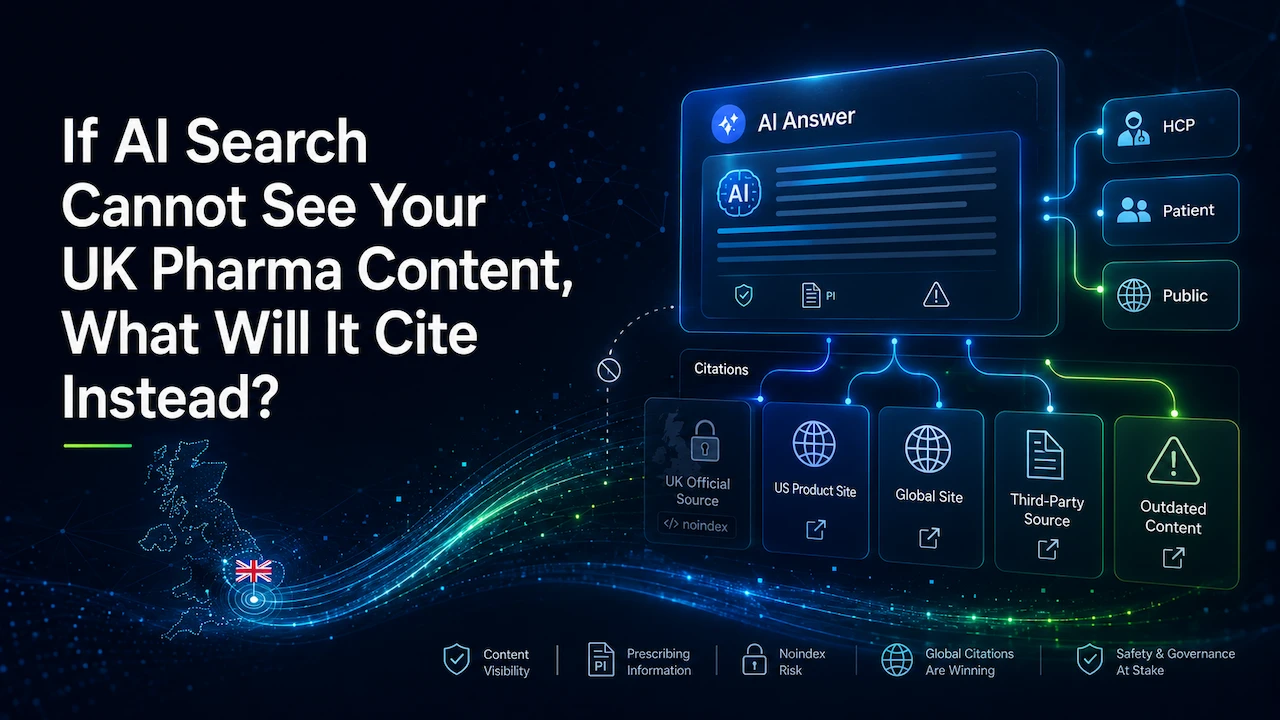
If the official UK content is hidden from search and AI systems, the answer engine may look elsewhere. That elsewhere could include:
- a US product website
- a global brand page
- a country-specific page for another market
- an international prescribing resource
- a third-party medicine information website
- older content that is easier to discover
- content written for a different audience or regulatory context
For a UK pharma team, that matters.
A US page may be accurate for the US market but not appropriate for a UK audience. A third-party source may be helpful but outside the company’s governance. A global page may not reflect UK labelling, access, wording, safety information, patient support arrangements or prescribing context.
The AI answer may look confident. It may even cite sources. But those sources may not be the ones the UK team would want a patient, HCP or member of the public to rely on.
The old question was access. The new question is citation
Historically, pharma website governance has focused heavily on access.
- Can the public access HCP promotional material?
- Are HCP and patient journeys clearly separated?
- Is prescribing information available where required?
- Is the content approved, current and appropriate for the intended audience?
Those questions still matter.
But AI search adds another layer:
If AI systems answer questions about our product, which sources are they likely to cite?
That is a different kind of governance problem. It sits between compliance, medical review, SEO, content architecture and digital strategy.
It also exposes a tension.
UK pharma teams may be doing the right thing by preventing certain content from being publicly indexed. But if there is no well-structured, indexable, UK-specific, non-promotional source layer, AI systems may fill the gap with whatever else they can find.
That is the uncomfortable part.
The company may have carefully governed its UK website, but the AI answer may still be shaped by content outside that UK governance model.
The answer is not “index everything”
This does not mean pharma companies should make all HCP or promotional content publicly indexable. That would be the wrong conclusion.
The answer is more nuanced.
Pharma teams need to think about what content should be visible, what should remain restricted, and what official UK source layer should exist for AI search and traditional search to interpret.
In practical terms, that might mean reviewing:
- whether the UK site has clear, indexable, non-promotional public information where appropriate
- whether patient and HCP content is separated in a way that is both compliant and technically clear
- whether product-related pages clearly signal country, audience and intended use
- whether UK pages are stronger and clearer than international alternatives for UK-relevant searches
- whether metadata, structured content, internal linking and page copy reinforce the correct source hierarchy
- whether noindexed pages are being used deliberately, rather than as a blanket technical habit
- whether AI search results are being monitored for priority brands and product queries
The goal is not to chase every AI citation. It is to reduce the risk that AI systems default to the wrong source because the right source is invisible, unclear or technically weak.
ABPI guidance may need to evolve
This is not a criticism of the ABPI Code.
The current Code was not written specifically for a world where AI answer engines summarise, blend and cite content from multiple jurisdictions in response to natural-language product questions.
The existing principles around audience separation, promotion, accuracy, balance and public access still matter. But the practical digital environment has changed.
AI search raises questions that sit just outside the traditional website governance model:
- Should companies assess how AI tools cite product-related information?
- Should there be clearer expectations around country-specific source control?
- How should UK companies balance
noindexcontrols with the need for accurate UK discoverability? - What should a compliant public source layer look like when AI systems are increasingly mediating search?
These are not abstract questions. They affect how real users may encounter information about medicines.
Pharma websites now need an AI citation review
For UK pharma teams, this should become part of digital governance.
Not because AI search replaces compliance review. It does not.
But because approved content sitting unseen behind technical controls may not shape the answer a user receives.
A practical AI citation review would look at priority product, therapy-area and brand queries and ask:
- What does AI say?
- Which sources does it cite?
- Are those sources UK-specific?
- Are they owned, approved or third-party?
- Is the user’s likely audience understood?
- Are HCP, patient and public contexts being blurred?
- Is the company’s own UK content visible enough to be useful?
- Are there gaps where a clearer public information page is needed?
That review should involve digital, medical, regulatory and commercial stakeholders. This cannot sit only with SEO, because the issue is not simply visibility. It is source quality, audience context and governance.
The bigger risk is assuming invisibility equals control
For years, pharma teams have often thought about digital risk in terms of what their own website exposes.
AI search means they also need to think about what happens when their website does not expose enough of the right information.
If the official UK source cannot be seen, cited or understood, AI systems may not wait politely. They may use another source.
That source may be from another country.
It may be from a third party.
It may not reflect the UK context.
Or it may not even be the source the company would choose.
That is why AI search should not be treated as a future SEO trend. For regulated pharma teams, it is already a governance issue.
And the question is simple:
If AI search cannot see your UK pharma content, what will it cite instead?
Need to understand how AI search is interpreting your pharma content?
 Genetic Digital helps healthcare, pharma and life sciences teams review website structure, content visibility and digital governance in regulated environments.
If you are concerned about how your product, therapy-area or corporate content is appearing in AI search, we can help you identify what is visible, what is missing and where the main citation risks sit.
If you want to understand what AI search is citing about your brand, let’s talk.
You can also learn more about our Healthcare & Pharma SEO, GEO and AEO solutions.
