

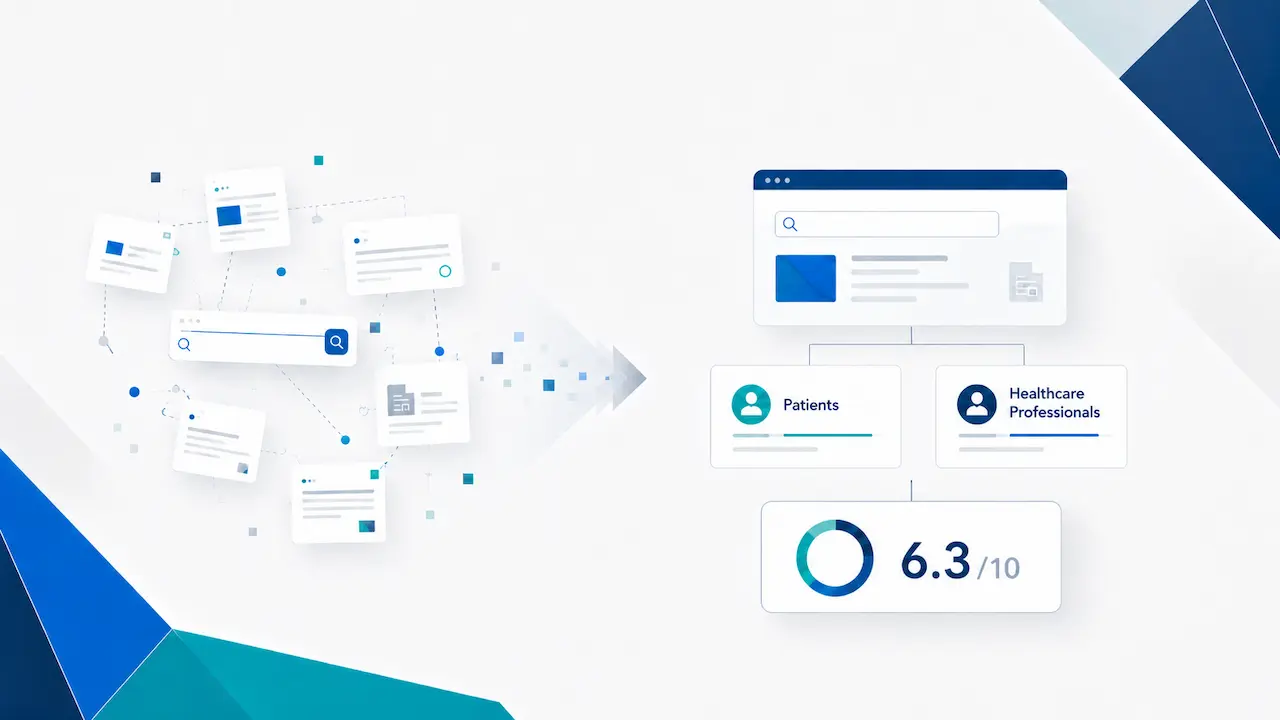
When patients, healthcare professionals or carers search online for information about a prescription medicine, what do they actually find?
In some cases, they find a clear, company-designed product-information estate: structured pages, useful audience routes, visible prescribing information, patient resources and clear adverse event reporting pathways.
In many other cases, they find something much thinner.
Often, the public-facing digital presence around a product is limited to regulatory listings, scattered documents, difficult-to-follow pathways or inconsistent information across the wider portfolio.
That gap matters more than it used to.
Search behaviour is changing. Patients are increasingly likely to search before or after a consultation. HCPs may use search to check prescribing information, find adverse event reporting routes or access patient support materials. And as AI-powered search tools begin to interpret and summarise healthcare information, the structure and clarity of a company’s digital estate may increasingly affect whether its product information is visible, accessible and usable.
That is why Genetic Digital created the UK POM Product-Information Estate Benchmark 2026.
The benchmark assessed 100 UK marketing authorisation holders across eight publicly visible dimensions, including product visibility, audience routing, prescribing information access, UX and findability. It is not a regulatory audit, ABPI compliance assessment or judgement on internal compliance processes. It is a practical assessment of what the outside world can see, navigate and use.
A market at very different stages of digital maturity
The benchmark found a significant spread in digital estate maturity across mid-specialty and small-specialist UK POM companies.
The average maturity score across the assessed cohort was 6.3 out of 10.
That figure is important because it suggests many companies have some form of public product-information presence, but not always one that is clear, complete, well-structured or easy to navigate.
The findings also show a market divided between stronger digital estates and more fragmented estates:
- 60% of companies were classified as having a limited or fragmented estate
- 13% had a minimal or unverified estate
- only 13 companies in the mid-specialty cohort were rated as strong exemplar estates
- the Big Pharma comparator group scored an average of 9.4 out of 10
- the gap between the mid-specialty average and the Big Pharma comparator average was 3.1 points
That 3.1-point gap is not simply a cosmetic difference. It points to a practical difference in how easy it is for users to find, understand and navigate product-level information.
This is not just a website issue
It would be easy to frame this as a website problem. In reality, it is broader than that.
A company’s product-information estate may include corporate website content, product pages, HCP areas, patient resources, prescribing information documents, adverse event reporting routes, regulatory listings and other public-facing assets.
The issue is not whether every company needs a large product website for every medicine. In many cases, that would be unnecessary.
The more useful question is:
When someone searches for information about one of your products, is the route clear, credible and useful enough for the context they are in?
For patients, that may mean understanding where to find patient-facing information and support.
For HCPs, it may mean quickly locating prescribing information or product-specific resources.
For carers or members of the public, it may mean avoiding confusion between professional, patient and regulatory content.
For internal teams, it may mean having a digital estate that is easier to govern, update and explain.
A weak estate does not automatically mean a company is non-compliant. But it may mean the public-facing experience is harder to use than it needs to be.
Why product-information estates matter now
1. Search is now part of the product-information journey
Users do not always begin on a company homepage. They search for product names, active ingredients, prescribing information, patient support resources and adverse event reporting routes.
If the company-designed layer is weak or missing, users may be pushed towards regulatory listings alone. These are important, but they are not designed to do every job that a well-structured product-information estate can do.
2. AI search will raise the importance of structure
As search moves beyond lists of links towards summaries and interpreted answers, clear structure becomes more important.
AI-powered tools are more likely to depend on information that is visible, well-organised, consistently labelled and easy to interpret. Poorly structured or fragmented estates risk becoming harder to understand in this environment.
That does not mean pharma companies should rush into AI-led content production. It means they should first make sure the public digital estate around their products is structured, governed and understandable.
3. Digital maturity affects confidence
In regulated healthcare, digital confidence is not built by visual design alone.
It is built by clarity, routing, consistency, accessibility, appropriate audience separation, findability and trust signals.
When users encounter a thin or fragmented estate, the organisation may appear less mature digitally, even where strong internal processes exist behind the scenes.
What stronger estates tend to do better
The strongest product-information estates are not necessarily the largest or most expensive.
They tend to be clearer.
They make it easier to understand which information is for patients, which is for healthcare professionals and where regulated documents can be found. They reduce ambiguity. They provide more coherent pathways from search to useful information. They make prescribing information and adverse event reporting routes easier to locate. They are structured in a way that supports users and internal governance.
For many mid-specialty and specialist pharma companies, the opportunity is not to copy Big Pharma estate models wholesale.
The opportunity is to build a proportionate, well-structured, company-designed layer around product information, based on the size of the portfolio, audience needs, internal capacity and commercial priorities.
A practical next step for UK POM companies
The benchmark is intended to help teams understand the maturity of the public-facing product-information landscape and identify where improvement may be needed.
For companies with fragmented estates, the first step is not always a full rebuild. It may be a focused review of:
- how products are surfaced online
- whether audience routes are clear
- how prescribing information is accessed
- whether adverse event reporting routes are visible enough
- how product, patient and HCP content is structured
- whether the estate is findable through search
- where inconsistency or friction may be creating avoidable user problems
This kind of review helps teams make more informed decisions before investing in new pages, portals, content structures or platform changes.
Private product-information estate reviews
 Genetic Digital is now offering private, fixed-scope product-information estate reviews for UK POM companies.
Each review provides a scored, benchmarked assessment of a company’s public digital estate, including a traffic light summary, therapy area peer comparison and prioritised recommendations.
Companies do not need to have appeared in the benchmark sample to request a review.
For more information, visit: https://www.geneticdigital.co.uk/benchmark-review/
