

Too many healthcare AI discussions still sound like this: we’ll tighten governance once the rules are final.
That may feel sensible internally. In practice, it is a weak operating model for digital health and med-tech teams building products that need trust, smoother procurement and stronger governance.
The more useful commercial view is simpler: healthcare AI readiness is already a digital product governance issue.
For teams building healthcare websites, web platforms, HCP portals and regulated apps, the question is no longer whether governance will matter more. It is whether the product is already being designed and built with the right level of control, clarity and oversight.
Why this matters now
A lot of teams are still treating AI governance as something that sits above the product: a policy issue, a regulatory issue, or a document to tidy up later.
That is the mistake.
In practice, governance problems tend to show up much earlier:
- in vague intended use
- in unclear product claims
- in outputs that are hard to review or challenge
- in weak auditability
- in fuzzy ownership of safety, privacy and escalation
- in poor monitoring after launch
That is why this matters commercially, not just legally. Weak governance can make a product harder to defend, harder to trust and harder to buy.
Why this matters for websites, platforms and regulated apps
This is especially relevant to the kinds of products many healthcare and med-tech firms are now building.
On a healthcare website, AI may be used for search, content discovery, guided journeys or content assistance. On a web platform or HCP portal, it may be used for summaries, prompts, recommendations or workflow support. In a regulated medical device app, AI may sit even closer to decision-making, monitoring or interpretation.
In each case, the governance issue is not just whether the AI works.
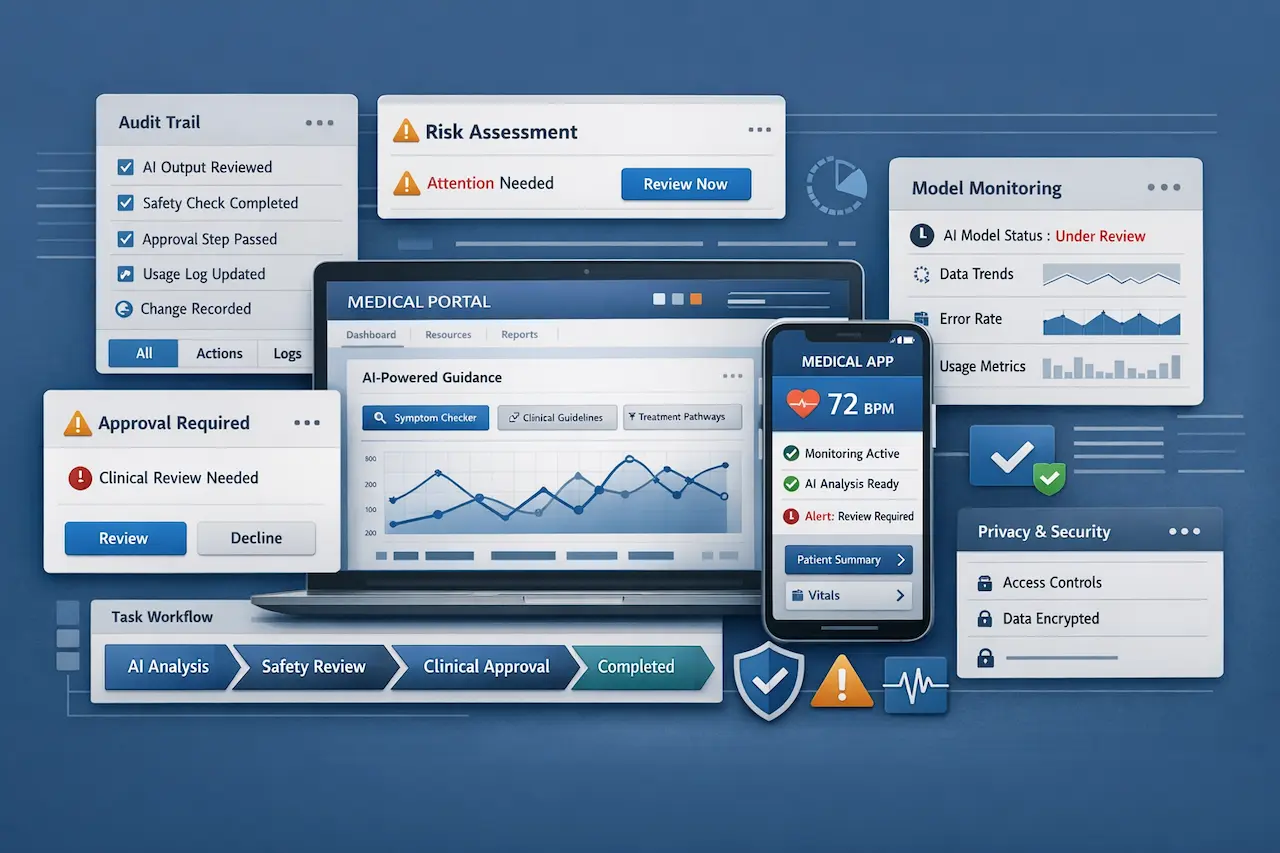
It is whether the surrounding digital product has been designed to govern it properly:
- are the claims clear?
- is intended use defensible?
- can outputs be reviewed and challenged?
- is uncertainty communicated properly?
- are actions, approvals and changes traceable?
- is monitoring built in after launch?
That is why AI governance in healthcare is not just a regulatory issue. It is also a design, UX, content, platform and development issue.
Five areas teams should fix now
1. Intended use and feature definition
Many teams still describe AI features too loosely.
A website feature may be presented as simple content assistance, when it is actually shaping interpretation. A portal may be described as workflow support, when it is already summarising or recommending. A regulated app may blur the line between support and decision influence.
That matters because once feature scope drifts, governance risk increases.
Teams need intended use to be clear not just in documents, but in the product itself: the wording, the interface, the outputs and the workflow.
2. Output review and control
A lot of AI conversations focus on models. Buyers and users will care just as much about outputs.
If your product generates summaries, prompts, recommendations or next-step suggestions, the questions become practical:
- who reviews the output?
- what can be actioned?
- what must be amended?
- what must be escalated?
- how is uncertainty shown?
This is where design matters. Output governance affects screen design, warning cues, approval steps, audit trails and user confidence.
3. Safety, privacy and ownership
In regulated healthcare products, governance cannot sit only with product or engineering.
Clinical safety, privacy, operational ownership and escalation all need to be clear enough to hold up in real-world use.
For websites, platforms and apps, that affects more than documentation. It influences access controls, content visibility, workflow routing, integration logic, incident handling and change control.
A polished product with weak ownership is still a weakly governed product.
4. Evidence and credibility
A lot of healthcare AI products still speak more confidently than they can prove.
That becomes a problem quickly. If claims are stronger than the underlying evidence, the weakness tends to show up everywhere: in the sales story, in procurement scrutiny, in internal challenge and in lower trust.
For digital teams, this means evidence planning should shape delivery earlier. Products need clearer thinking around claims, outcomes, limitations, reporting and what success actually looks like in use.
5. Monitoring and change control
This is one of the biggest weak spots.
Many teams think about launch, but not enough think about what happens after launch:
- what gets monitored?
- what counts as an incident?
- what happens when prompts change?
- what happens when models, integrations or workflows change?
- what gets logged for traceability?
- when does a change require reassessment?
This is especially important where websites and platforms integrate third-party AI services. The core issue is not just whether the product works today, but whether it can still be governed properly as it evolves.
What good looks like
Before any final framework lands, stronger teams should already be able to show:
- a clear intended use
- defined ownership across product, safety, privacy and operations
- documented output-review workflows
- evidence plans linked to product claims
- auditability and traceability built into the platform
- monitoring and escalation processes
- change control across prompts, models, integrations and workflows
That is what makes a healthcare website, platform or app easier to trust.
The real commercial lesson
The organisations most likely to struggle are not necessarily the ones with the most ambitious AI roadmap.
They are the ones still treating governance as something that sits outside the product.
The organisations more likely to win trust will be the ones that build governance into the delivery layer from the start: website structure, UX, content, output design, workflow logic, auditability, integrations and operational controls.
For digital health and med-tech teams, AI readiness is not just about whether the AI feature works. It is about whether the surrounding product has been designed and built to govern it properly.
That is where Genetic Digital can help.
We work with healthcare and life sciences teams on the practical delivery layer behind trust: healthcare websites, custom web platforms and regulated medical apps where intended use, user journeys, output design, governance touchpoints and platform controls all need to work together.
Sources referenced
- MHRA Regulation of AI in Healthcare call for evidence
- MHRA National Commission into the Regulation of AI in Healthcare
- MHRA Software and AI as a Medical Device change programme roadmap
- MHRA AI Airlock collection
- MHRA implementation of the future regulations for medical devices in Great Britain
- NHS England guidance on AI-enabled ambient scribing products
- NICE evidence standards framework for digital health technologies
- NICE update on expanding technology appraisals to digital health technologies
- NHS England Digital Technology Assessment Criteria (DTAC)
